SAP S/4HANA as an opportunity: Why companies should rethink their product data now
The migration to SAP S/4HANA has been underway for more than ten years. Yet many companies are only now realizing that the real transformation is taking place outside the ERP system.
18. Juni 2026, Autor*in: Petra Seifert, myview systems GmbH
The major SAP transformation is underway – but what does it mean for product data?
For many companies, migrating to SAP S/4HANA is currently one of the most important IT projects of the coming years. The approaching end of support for SAP ECC is forcing many organisations to modernise their ERP landscape and make strategic decisions about their future IT architecture.
Yet while discussions often focus on cloud models, migration strategies and project costs, one key question is often raised only at a later stage:
Which data actually still belongs in the ERP system in the future?
This is where the real opportunity of the transformation begins. During their SAP migration, many companies are realising that product information today needs to do far more than simply support master data management.
SAP remains important – but no longer for everything
In the past, SAP was often the central platform for almost all corporate data. Product information, technical specifications, sales information, marketing copy and, in some cases, even media content were managed directly in the ERP system.
However, this model is increasingly reaching its limits.
The requirements of modern companies have changed:
- Products are marketed across numerous channels.
- E-commerce continues to grow.
- Marketplaces require detailed product information.
- Customers expect consistent information across all touchpoints.
- AI applications require high-quality, structured data.
- ERP systems such as SAP are ideally suited to business processes, financial data and transactions. However, they were never designed to manage complex product
For many companies, the question today is therefore no longer:
" Do we need SAP?"
But rather:
"What role should SAP play in our data architecture in the future?"
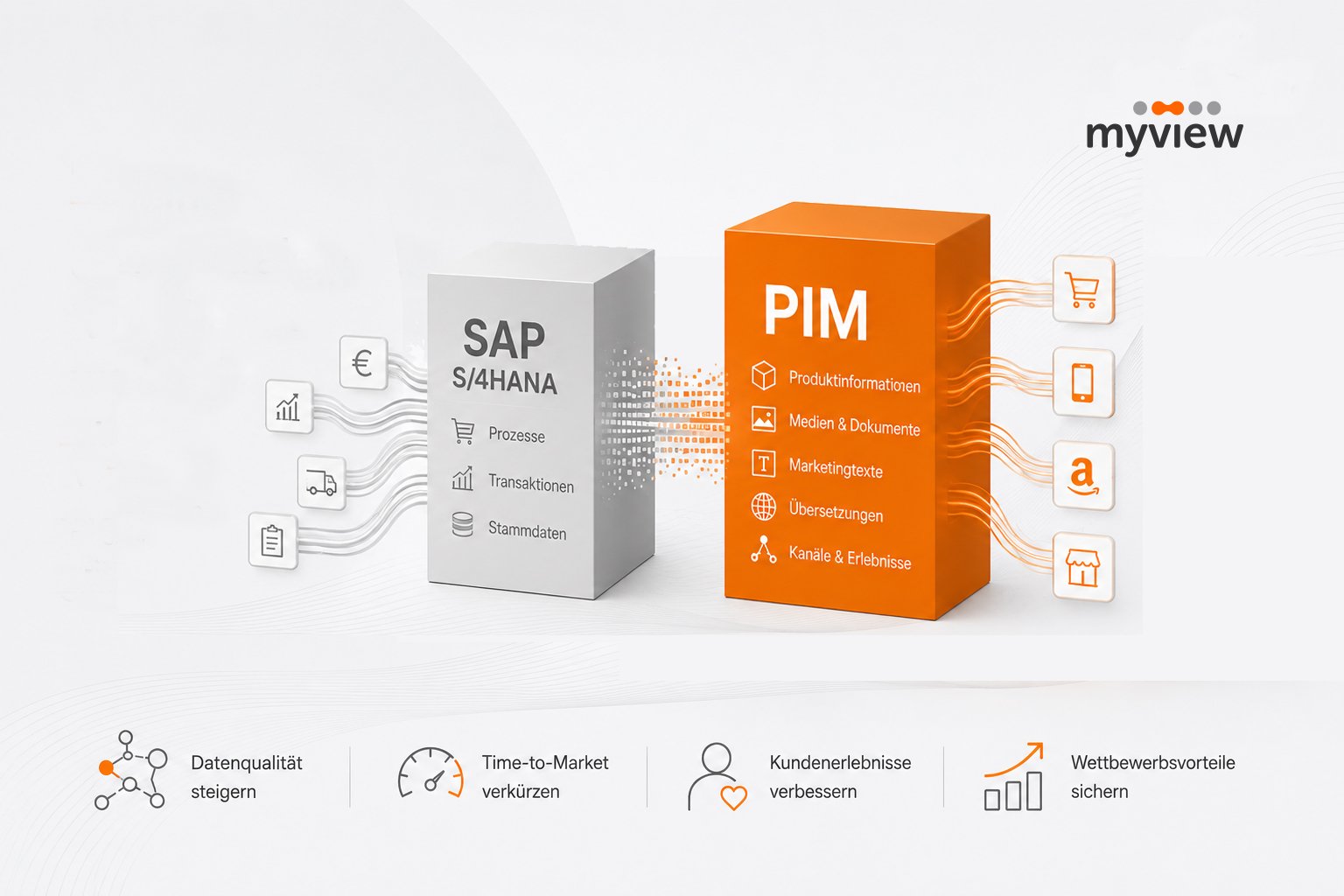
The new architecture: ERP and PIM working together
As part of the S/4HANA transformation, more and more companies are opting for a clear division of responsibilities.
This often results in the following structure:
ERP system
- Prices
- Inventory levels
- Material master data
- Purchasing and sales processes
PIM system
- Product information
- Marketing copy
- Technical specifications
- Media and documents
- Translations
- Channel management
The PIM system becomes the central platform for all product-related information, while the ERP system manages the commercial processes.
This separation creates transparency, reduces complexity and enables significantly faster processes in sales and marketing.
Why SAP migration often leads to a PIM project
Many companies start their S/4HANA migration with a purely technical focus. However, as the project progresses, familiar challenges often come to light:
- Product data is spread across multiple systems.
- Marketing teams work with Excel files.
- Product information is incomplete or outdated.
- E-commerce teams maintain the same data multiple times.
- Different countries and business units use different data structures.
The result:
The SAP transformation reveals that the ERP system itself is not the real problem. The real issue is the lack of a clear product data strategy.
For this reason, many PIM projects are now implemented alongside ERP modernization initiatives.
Practical example: A mechanical engineering company on its way to the future
A medium-sized mechanical engineering company is planning to introduce SAP S/4HANA.
At the beginning of the project, the focus is on processes, finance and materials management. During the analysis phase, however, it becomes clear that:
- Product data is maintained in SAP, Excel and various databases.
- Technical documentation is stored in different locations.
- Product information for the online catalogue has to be compiled manually.
- International subsidiaries use different versions of the data.
Instead of transferring these structures unchanged to S/4HANA, the company decides to implement a new architecture.
SAP will take on the role of the ERP core.
A PIM system will become the central platform for all product information.
The result:
- Higher data quality
- Faster product launches
- Consistent information across all sales channels
- Considerably less effort required for data maintenance
This example is representative of many companies that use their SAP transformation as an opportunity to modernize their entire product data.
What impact does this have on the PIM market?
The current ERP transformation is reshaping the PIM market.
In the past, the typical question was:
“Do we even need a PIM system alongside SAP?”
Today, the question is increasingly:
“How can we best integrate our PIM into the SAP landscape?”
This reflects a fundamental shift.
Product information is increasingly seen as a strategic success factor, especially in industries with:
- complex product complex product portfolios
- international markets
- e-commerce activities
- high pressure to innovate
At the same time, topics such as artificial intelligence, automated content creation and omnichannel commerce are becoming increasingly relevant.
High-quality product data provides the foundation for all these initiatives.
Why companies should act now
The coming years will be shaped by ERP and cloud transformations for many companies.
Companies that view the migration to SAP S/4HANA solely as a technical upgrade are missing valuable opportunities.
The real opportunity lies in critically reviewing existing processes and data structures:
- Where do media disruptions occur?
- Which data is maintained multiple times?
- What information is missing for e-commerce and sales?
- How can product data be used more efficiently?
Companies that address these questions early on lay the foundation for sustainable growth and digital competitiveness.
Conclusion
The introduction of SAP S/4HANA is much more than an ERP project.
It gives companies the opportunity to redesign their entire data architecture and strategically redefine the role of product information.
SAP remains a central component for business processes and transactions.
For the management, enrichment and distribution of product information, however, more and more companies are turning to specialized PIM solutions.
Companies that use the current transformation phase to intelligently decouple ERP and product data lay the foundation for better customer experiences, more efficient processes and future AI applications.
How does myview support you?
At myview, we help companies make their product data strategy fit for the future.
We help you:
- analyze product data processes,
- develop suitable PIM strategies,
- and make product information efficiently available for:
- master data governance / data quality management,
- classification management,
- product compliance,
- sales and marketing.
Are you currently planning an SAP transformation or looking to modernize your product data architecture?
Talk to our experts and find out how a modern PIM strategy can support your transformation project in the long term.
Book a consultation