Data Intelligence in the Lighting Industry
August 12, 2026| Author: Petra Seifert, myview systems GmbH
How Intelligent Product Data Drives Visibility, Lighting Design and Luminaire Sales.
Whether in lighting design, electrical wholesale or digital applications, the demand for product information in the lighting and luminaire industry continues to grow.
It is no longer just about efficiently managing technical data. What matters is how manufacturers use their product information to increase visibility in planning processes, serve different sales channels and unlock new digital opportunities.
Product data is thus evolving from an operational necessity into a strategic success factor.
A PIM system offers significant strategic and operational benefits for companies managing a large number of products, variants, or sales channels.
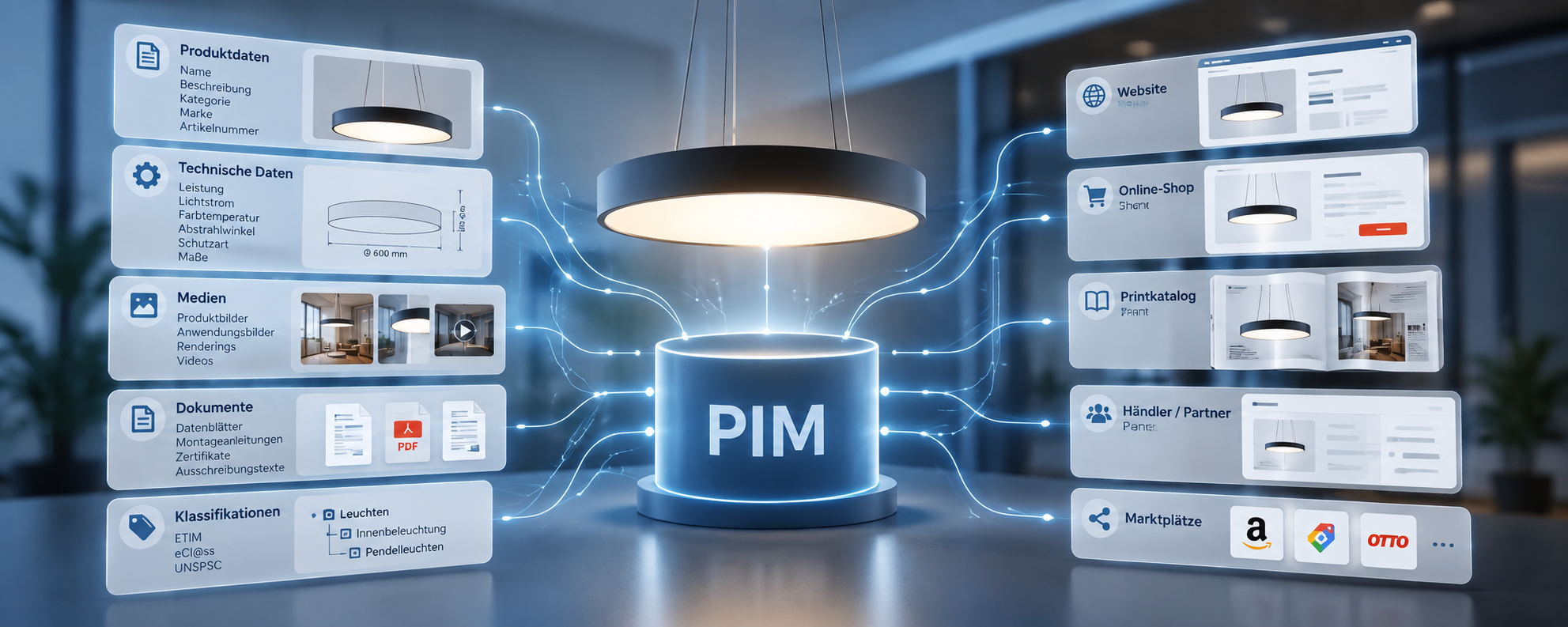
PIM at the Core
As the single, central, and reliable source for all product information.
Luminaires are technically complex products. Different components, performance characteristics, variants and configuration options place high demands on the management and provision of product information.
At the same time, this data is needed across a wide range of applications: in electrical wholesale, professional lighting design, digital product configurators and increasingly in automated and AI-powered applications.
The foundation for all of this is a centralized, reliable data source – a Single Point of Truth that supplies different systems and applications with exactly the information they need.
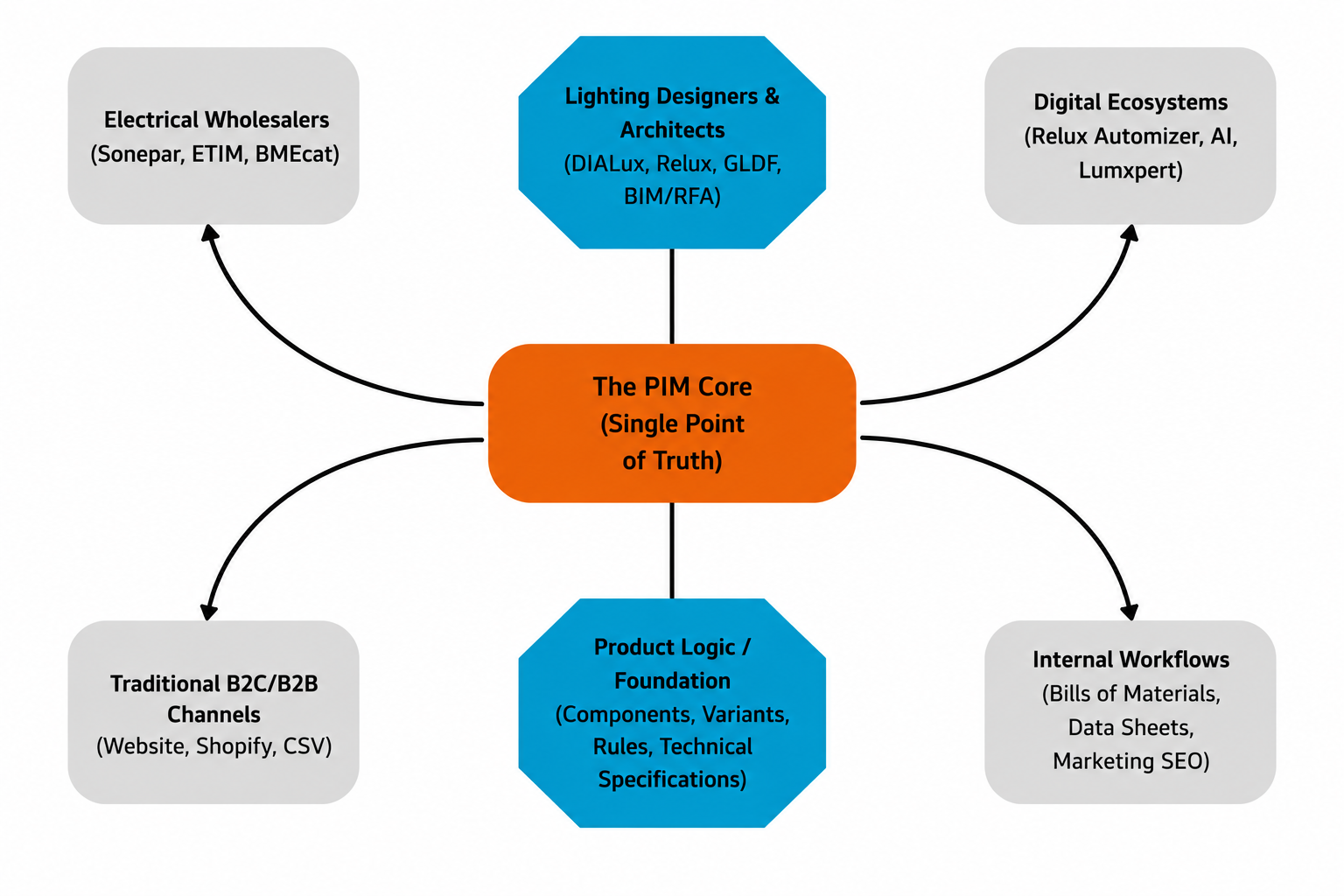
However, the true value of intelligent product data only emerges when it is put to use. Three stages of development can be identified.
This step focuses on managing internal complexity and laying the groundwork for sales.
Error-Free Product Variants
Luminaires often consist of countless combinations of different components: housings, drivers, LEDs and optics. By defining fixed rules and product logic in the PIM, technically impossible configurations can be prevented from being configured and ordered. This significantly reduces the return rate.
Faster Product Listings
Companies that can export industry-specific formats natively and without errors are more likely to be listed by electrical wholesalers. This allows new products to go live on platforms within hours rather than weeks.
Efficient Data Maintenance
Instead of manually entering information into data sheets, websites or Excel spreadsheets, the Single Point of Truth supplies all channels simultaneously. This saves up to 80% of administrative effort, freeing up time for more valuable tasks.
Managing Complexity and Laying the Foundation for Efficient Processes and Digital Sales Channels.
Effectively Managing Product Variants
Luminaires often consist of numerous combinable components, including housings, drivers, LEDs, optics and other technical features. The resulting variety of product variants must not only be managed but also accurately represented from a technical perspective.
Defined product logic and rules help prevent invalid combinations and ensure consistent product information. This reduces errors and provides greater reliability in product configuration and ordering.
Providing Product Data for Electrical Wholesalers
For luminaire manufacturers, the reliable provision of product information to electrical wholesalers is a crucial part of their sales processes.
Industry-specific standards and data exchange formats such as ETIM and BMEcat enable structured data exchange. By centrally managing and appropriately preparing the required information, manufacturers can communicate new products and changes to their product ranges to trading partners more efficiently.
Streamlining Data Management and Processes
Technical data sheets, product catalogs, websites and other sales channels often require the same information – but in different formats and combinations.
A centralized data source eliminates redundant data maintenance processes and enables the automated provision of the information required for each channel.
This not only increases efficiency but also lays the foundation for using product data beyond traditional applications.
“If your products aren’t featured in the architect’s or lighting designer’s planning software, they won’t be specified for projects.”
If your products are not included in the architect’s or lighting designer’s planning software, they will not be installed.
Gaining Visibility Where Products Are Selected and Decisions Are Made.
In the lighting industry, product selection often begins long before an order is actually placed.
Lighting designers and architects use specialized planning software in which technical specifications, light distribution patterns and other product information play a key role. Manufacturers whose products are represented in these digital planning processes increase their chances of being considered at an early stage.
Making Products Directly Available in Lighting Design
Lighting design software such as DIALux and Relux enables designers to integrate specific luminaires into lighting calculations and projects.
By providing the required product data in the appropriate quality and structure, manufacturers can make their products directly available within these planning environments.
Once a luminaire has been incorporated into a lighting design, this can also influence the final product selection. Switching to a different product often requires additional verification and planning effort.
BIM as a Gateway to Digital Construction Processes
Building Information Modeling (BIM) is becoming increasingly important in the planning and execution of construction projects.
For luminaire manufacturers, this creates additional requirements for providing structured product information and digital product models.
Manufacturers who meet these requirements make it easier to integrate their products into digital planning processes and improve their chances of being considered for relevant projects and tenders.
Enabling Digital Configuration of Complex Products
Selecting the right configuration can be particularly challenging for continuous-row lighting systems, industrial luminaires and other products with numerous variants.
Digital product configurators enable customers, lighting designers and field sales teams to independently configure solutions that meet their specific requirements.
The underlying product logic and technical rules ensure that only valid combinations are possible.
This reduces the workload for technical sales teams and makes complex products easier to configure and access.
The Lock-in Effect
Direct Access to Large-Scale Projects Through BIM
In modern construction projects, investors often require BIM data. By providing this data, you meet a key requirement for participating in tenders for airports, hospitals or office complexes.
More Self-Service Configurations
Customers and field sales teams can configure complex lighting systems or industrial luminaires themselves using an online configurator. This reduces the workload for internal technical sales teams and can lead to a substantial increase in online conversion rates.
This is where the line between product manufacturer and digital service provider begins to blur.
When Product Data Becomes the Foundation for New Digital Services and Intelligent Applications.
When systems such as Relux Automizer use machine learning to automatically design lighting for spaces, manufacturers whose data is perfectly structured in the GLDF format benefit. The system selects your luminaire because the algorithm can accurately interpret its clean and consistent data structure.
By integrating your data directly into platforms such as Lumexport or Sonepar, your products become part of the electrician’s digital bill of materials. This allows you to reach installers directly within the tools they use in their daily work.
Automatically generated tender specifications and AI-powered advice on your website make planning easier and more efficient for lighting designers.
The Digital Product Passport will become mandatory across the EU. Companies that can automatically provide the required information using PIM data will secure their long-term market access and gain an advantage in sustainability-certified construction projects.
What makes PIM so important?
Increased Efficiency and Cost Reduction
By centralizing data in one place, companies can avoid scattered and inconsistent information. Product logic and automated workflows also minimize manual data maintenance. New products or product range extensions can be created, approved and published across all channels in record time.
Improved Data Quality and Consistency
Mandatory fields, validation rules and automated quality checks prevent incorrect or incomplete data from leaving the system. Product descriptions and technical specifications are maintained centrally and automatically formatted for each channel. Consistent product data helps customers develop realistic expectations, reducing incorrect purchases and, consequently, return costs.
Scalability and Simplified Omnichannel Marketing
Translation workflows and the management of currencies, units of measurement and legally required information make internationalization easier. Delivering accurate data from the PIM to each channel simplifies omnichannel marketing. Complex product relationships, accessory links and variant structures can also be managed clearly and efficiently.
Reduced Workload for Employees and Better Collaboration
Clear roles and permissions define exactly which employees can edit and approve specific data, ensuring well-structured processes. In addition, time-consuming copy-and-paste tasks in product management and marketing are streamlined, leaving more time for strategic product development, SEO optimization and content creation.
PIM as the Key to Agility
A seamless digital process transforms a data-intensive product such as a luminaire into an agile digital asset.The greatest advantage is eliminating breaks in the flow of information between systems. Once the data is stored in the PIM, it drives all subsequent processes, from lighting calculations in DIALux and robotic control in Relux Automizer to invoicing in the Sonepar project environment.